Category: The Blog
Female writers: Are they overlooked?
This Village Voice article raises the question of whether female writers are overlooked. What do you think?
The New York Review of Books publishes mostly men, and in that, they’re not alone, joined by pretty much every major print magazine in this country. But the NYRB’s editor, Robert Silvers, responded to a criticism of their mostly-maleness this week with an amazing, somewhat baffling form letter. The letter, which was sent to multiple people who complained about a specific issue of the magazine, lists every woman the NYRB has printed in the last year. That didn’t take long, considering there were 40 of them total, compared to 215 or so male reviewers. Happy now, ladies?
See also:
– Who Writes for the Times’s Front Page? Mostly Dudes, As It Turns Out
We’ve written before about VIDA, an organization devoted to promoting women in literature and journalism, who each year publish the Count, a breakdown of just how bad the gender gap in major magazines is. The NYRB, says VIDA spokesperson Erin Belieu, “has been one of the worst offenders over the 3 years we’ve conducted our Count.”
But VIDA’s membership was pushed over the edge by the August 15 issue, which, even by the low standards of women’s inclusion in media, is pretty bad. VIDA says there was one woman and over two dozen male contributors; looking at the issue online, I see two women, a review by April Bernard and a closing essay by Joan Didion, “The Deferential Spirit,” a reprint of a 1996 piece. (Update, 10:00 a.m.: VIDA’s Count Director, Jen Fitzgerald, explained the discrepancy in a brief phone call. In assessing the NYRB, she says, they only look at the main part of the magazine, the reviews, noting the gender of the reviewers and of the authors being reviewed. Letters to the editor and closing essays are not included in the count.)
In either case — one or two women to several dozen men — the ratio isn’t great. So VIDA sent a letter to the NYRB:
To the Editors,
We write to express our disappointment with NYRoB’s editorial practices. Your organization’s ongoing dismissal of women writers generally is exhibited yet again in your August 15th issue. That issue included 26 pieces by male writers and 1 by a female writer. Of the 29 books reviewed, only four were written or co-written by women.
We at VIDA: Women In Literary Arts have been publishing our much discussed Count since 2010, documenting the rates of publication between male and female writers in major American literary venues.
In a country in which women represent the majority of literary consumers, this gender bias on your part has come to appear willful, or else weirdly tone deaf to the cultural conversation happening around you. We strongly suggest you open your ears if you wish to remain a relevant force in our literary culture.
As the writers associated with VIDA’s leadership represent both established and emerging authors across all genres, we know that major literary reviews solicit most, if not all, of their content; therefore, responsibility for your distinction as one of the worst offenders included in VIDA’s Count rests with your editorial policies. At present, it appears that NYRoB believes women have little to add to our country’s literary conversation. We doubt your readers, a large proportion of whom are women, will continue to subscribe to a journal that pointedly devalues women’s contributions to our literary culture. Nor do we think your advertisers will continue to be comfortable supporting the message that men’s voices are the only voices of real value in our community. Times are changing. A wise man (or woman) looks to the future.
Besides VIDA, many of their supporters wrote similar letters. They didn’t necessarily expect a great response from the magazine, Belieu says, noting that a lot of publications that get called out by VIDA respond with “wounded, reactionary defensiveness.”
“We know that much of gender bias is unconscious,” she explains. “People aren’t sitting down daily in editorial staff meetings to actively plot ways to disenfranchise women writers. It’s much more subtle and pernicious than that.” Besides that, she adds, “Individuals mostly want to believe they are fair-minded people who make their decisions from a rational place. And men as a group put a high value on their supposedly rational approach to the universe. And writerly types generally want to believe themselves most particularly educated, sophisticated, liberal sorts.”
So the responses they tend to get are mostly along the lines of, as she puts it, “‘What are you talking about? Some of my best friends are lady writers! And look here, we had a woman in this issue. What more do you gals want?’ The thing they don’t want to say out loud–though many do from the easy anonymity of comment boxes–is that they truly believe men are simply genetically better writers than women.”
Silvers’ response didn’t even go that far, because he didn’t bother to engage in much discussion at all (nor did he respond to a request for comment from the Voice.) Instead, he sent this to VIDA’s leadership, and identical letters to everyone else who wrote in:
Dear Erin Belieu, Lynn Melnick, Suzanne Paola, Jennine Capo Crucet, Alyss Dixson, Amy King, Cate Marvin, and Ann Townsend,
In response to recent comments about contributions by women to the New York Review, I want to say that we certainly hope to publish more women writers. But I wonder if our critics have fairly considered the many reviews, essays, and poems by women that have appeared in the Review and on the Review’s blog. A list of their contributions just during our last year of publication follows. No one who has read the work of these writers could say that the New York Review dismisses the work of women writers generally, or that the New York Review “believes women have little to add to our country’s literary conversation.”
Print Edition:
Zoë Heller on Vagina: A New Biography by Naomi Wolf; Joyce Carol Oates on NW by Zadie Smith; Sue Halpern on four books about cyber hackers; Jenny Uglow on A More Perfect Heaven: How Copernicus Revolutionized the Cosmos by Dava Sobel; Helen Vendler on What Light Can Do: Essays on Art, Imagination, and the Natural World by Robert Hass; Cathleen Schine on Telegraph Avenue by Michael Chabon; Jana Prikryl on Pauline Kael and the movies; Ingrid D. Rowland on Money and Beauty: Bankers, Botticelli and the Bonfire of the Vanities; Marcia Angell on the Death with Dignity Act; Lovisa Stannow (with David Kaiser): “Prison Rape: Obama’s Program to Stop It”; Anne Applebaum on four books on Soviet spies; Elisabeth Sifton (with Fritz Stern): “The Tragedy of Dietrich Bonhoeffer and Hans von Dohnanyi”; Francine Prose on This Is How You Lose Her by Junot Díaz; Elizabeth Drew on the presidential election; Diane Johnson on How Should a Person Be? by Sheila Heti; Rachel Polonsky on Living Souls by Dmitry Bykov; Mary Beard on How to Win an Election: An Ancient Guide for Modern Politicians by Quintus Tullius Cicero; Alma Guillermoprieto on mexican journalists risking life for truth; Jean Strouse on Portrait of a Novel: Henry James and the Making of an American Masterpiece by Michael Gorra; Anne Applebaum: “How the Communists Inexorably Changed Life”; Claire Messud on Astray by Emma Donoghue; Amy Knight on The Moscow Bombings of September 1999: Examinations of Russian Terrorist Attacks at the Onset of Vladimir Putin’s Rule by John B. Dunlop.
Janet Malcolm: “What Happened to Michelle Malakova in Forest Hills?”; Elaine Blair on Every Love Story Is a Ghost Story: A Life of David Foster Wallace by D.T. Max; Joyce Carol Oates on Freud’s Sister by Goce Smilevski; Janet Malcolm: “The Fate of Michelle Malakova”; Zoë Heller on Joseph Anton: A Memoir by Salman Rushdie; Elizabeth Drew on voter rights; Janet Malcolm: “Michelle: Surviving in a Fixed World”; Zadie Smith: “Joy”; Ingrid D. Rowland on the exhibition Late Raphael; Cathleen Schine on Blown Away and Dear Life by Alice Munro; Hermione Lee on two books by Colm Tóibín; Nomika Zion on Siderot and Gaza; Rosanna Warren: “Toward High Point” (poem); Yasmine El Rashidi: “Egypt: The Rule of the Brotherhood”; Lorrie Moore on Homeland; Marcia Angell: “How to Die in Massachusetts”; Claire Messud on The Life of Objects by Susanna Moore; Joyce Carol Oates on The Round House by Louise Erdrich; Helen Vendler on Now All Roads Lead to France: A Life of Edward Thomas by Matthew Hollis; Sue Halpern on two books about dogs; Helen Epstein on Lead Wars: The Politics of Science and the Fate of America’s Children by Gerald Markowitz and David Rosner; Elizabeth Drew: “Are the Republicans Beyond Saving?”; Fiona MacCarthy on The Pinecone: The Story of Sarah Losh, Forgotten Romantic Heroine–Antiquarian, Architect, and Visionary by Jenny Uglow; Cathleen Schine on Odds Against Tomorrow by Nathaniel Rich.
Francine Prose on The Accursed by Joyce Carol Oates; Florence Williams on Spillover: Animal Infections and the Next Human Pandemic by David Quammen; Diane Johnson on two books about Scientology; Alison Lurie on The Woman Upstairs by Claire Messud; Anka Muhlstein on the exhibition Impressionism, Fashion, and Modernity; Mary Beard on Spartacus by Aldo Schiavone; Marcia Angell on Triumphs of Experience: The Men of the Harvard Grant Study by George E. Vaillant; Joan Acocella on Isadora Duncan; Elizabeth Hardwick on Sylvia Plath (reprint); Anne Applebaum on Lean In: Women, Work, and the Will to Lead by Sheryl Sandberg with Nell Scovell and The End of Men and the Rise of Women by Hanna Rosin; Jenny Uglow on Consider the Fork: A History of How We Cook and Eat by Bee Wilson; Susan Sontag on Simone Weil (reprint); Zoë Heller on Forty-One False Starts: Essays on Artists and Writers by Janet Malcolm; Anna Somers Cocks: “The Coming Death of Venice?”; Joyce Carol Oates on two books by Derek Raymond; Aileen Kelly on Isaiah Berlin: The Journey of a Jewish Liberal by Arie M. Dubnov; Elaine Blair on Sontag: Reborn; Terry Castle on two biographies of Sylvia Plath; Hermione Lee on The Selected Letters of Willa Cather; Paula Bohince: “Carousel” (poem); Hannah Arendt: “Reflections on Violence” (reprint); April Bernard on Metaphysical Dog by Frank Bidart; Joan Didion on Bob Woodward (reprint).
NYRB Blog:
Foreign affairs (Alma Guillermoprieto on Venezuela, Stephanie Giry on Cambodia, Amy Knight on Russia, Haleh Esfandiari on Iran, Yasmine el Rashidi on Egypt, Sarah Birke on Syria, Ingrid Rowland on Italy);
Philosophy (Agata Sagan);
Politics (Elizabeth Drew);
History (Natalie Zemon Davis);
Human rights (Helen Epstein, Xiaorong Li);
Film (Francine Prose, Emily Eakin);
Television (Elaine Blair);
Poetry (April Bernard);
Art (Negar Azimi)
Yours sincerely,
Robert Silvers
The letter is odd for a couple of reasons, the main one being, as Belieu says, “As if we didn’t already have this information. Hence our letter.” The implication kind of seems to be that the ladies at VIDA don’t know how to count. And Silvers’ statement that the magazine “certainly hope[s] to publish more women writers” is oddly non-committal. It’s something you’d think he has control over, being the editor and all.
Judging from Silvers’ tone of total disinterest, that seems to be pretty much the end of that discussion.
“We don’t need them to engage if they don’t want to,” Belieu says. “But they–along with a bunch of other magazines– would benefit from actually listening to a conversation that is clearly important to a whole lot of literary consumers. What we’re asking them to do isn’t terribly difficult. Finding more super talented women writers really isn’t heavy lifting for an editor. And it could be a great pleasure if they’d allow it to be. As an editor for many years myself, I know that finding new voices is one of the most satisfying parts of the job.”
In the meantime, she says, “We at VIDA keep working to educate readers and writers about why it’s important to seriously consider what organizations you want to support. Like many others, I don’t eat at Chick-fil-a and I don’t shop at Walmart. I try and make ethical decisions as much as I possibly can about what I give my money to. We at VIDA will be encouraging others to do the same.”
There’s much more discussion about the NYRB over at VIDA’s Facebook page.
Bullying “reviewers”
To read the salon.com article about the bullying one author experienced, click here or read below.
 Enlarge (Credit: goodreads.com/Photo collage by Salon)
You don’t necessarily think of the world of bookworms would be full of bullies. Readers, after all, are assumed to be a more evolved species, capable of articulating higher sentiments that “You suck.” Well, not always. Just a short time ago, Lauren Howard was gearing up for the release of her self-published debut novel, “Learning to Love,” a tale in which “love at first sight isn’t always as simple as a fairy tale.” But then the Goodreads crowd reportedly decided to assert its dominance over the fledgling author, and that’s when things changed.
As the 22 year-old self-proclaimed “shopaholic, pop culture junkie, book lover and writer” explained on her blog Tuesday, she has now decided to not release the book, and the “main reason is recent occurrences on the website Goodreads.” She claims that though her book was not yet in the hands of potential reviewers, readers were already giving it two star reviews. “I asked about this on a Goodreads message board,” she says, “and it was explained to me that people can rate as a way of expressing their interest in the book.” But by then, she writes, she’d triggered the ire of some of the community for questioning it. “People started to rate 1-star to prove ‘we can rate whatever the hell we want.’ My book was added to shelves named ‘author should be sodomized’ and ‘should be raped in prison’ and other violent offensive things, all for asking a simple question as a newcomer to the website.” She adds that “I’ve contacted Goodreads directly and nothing has been done because, again, this is acceptable behaviour.”
Those earlier comments on Goodreads have now been deleted, so it’s impossible to gauge their severity, or how a young, debut author with a self-published book may have viewed them. And as a colleague says, “I’ve seen authors respond to a mixed Goodreads review as if the reader had burned a cross on their lawn.” But if you want a sense of how these things can go down, it’s notable that one of Howard’s remaining Goodreads commenters says that “Reviewers have the right to rate a book however they feel like, with absolutely no justification what so ever. Get over it princess.” And there’s a whole Stop The GR Bullies blog devoted to “Taking a Stand Against Bullies, Not Against Reviews,” which if nothing else offers a fascinating window into the complex web of Goodreads drama.
advertisement
Writing a year ago in HuffPo, author Ray Garton said, “If you think someone who writes a bad review of your book is bullying you, then you should quickly develop a thick skin or stop writing immediately and do something else.” But a bad review is not the same as a threat or intimidation, and frankly even a run of the mill pan based on an unread book is plain dishonest.
Howard, who describes herself as a woman who was “bullied throughout her entire high school career” says that “I have NEVER expected this journey to be all sunshine and rainbows, I knew some people would hate my book but I could have handled THOSE reviews. What I cannot handle and what I didn’t expect is being targeted PRIOR TO RELEASE by a group of bullies who have wished horrible things, including rape and death, on me” and that “I will not be a part of a site where it is acceptable to wish rape, sodomy, abuse and death on someone.” Though it’s only her word on this, given the ease with with rape and death threats are tossed around at women online, it’s certainly not difficult to imagine.
On Twitter Tuesday, she added that she was “literally scared” and had recently “had a few people contact me on Facebook with aggression.” But because the Internet community will almost always generously build you up to almost the degree it can tear you down, she’s also noted that she’s received “truly amazing” support. On Goodreads, meanwhile, a new crop of users has given her book four stars – a strange gesture for a now not-to-be-released title, to be sure, but in this case, a simple statement that critics can game the system in a more positive direction too. Yet the stars were never the point. Among the great arguments that the trolls and bullies love to fall back on is the idea that abuse is legitimate criticism. As author Jamie McGuire tweeted Tuesday, “Negative reviews are part of the business. Bullying authors shouldn’t be.” And a community that tolerates the latter in the name of the former is a community that might claim to espouse reading, but one that has a serious comprehension problem.
 Mary Elizabeth Williams is a staff writer for Salon and the author of “Gimme Shelter: My Three Years Searching for the American Dream.” Follow her on Twitter: @embeedub.
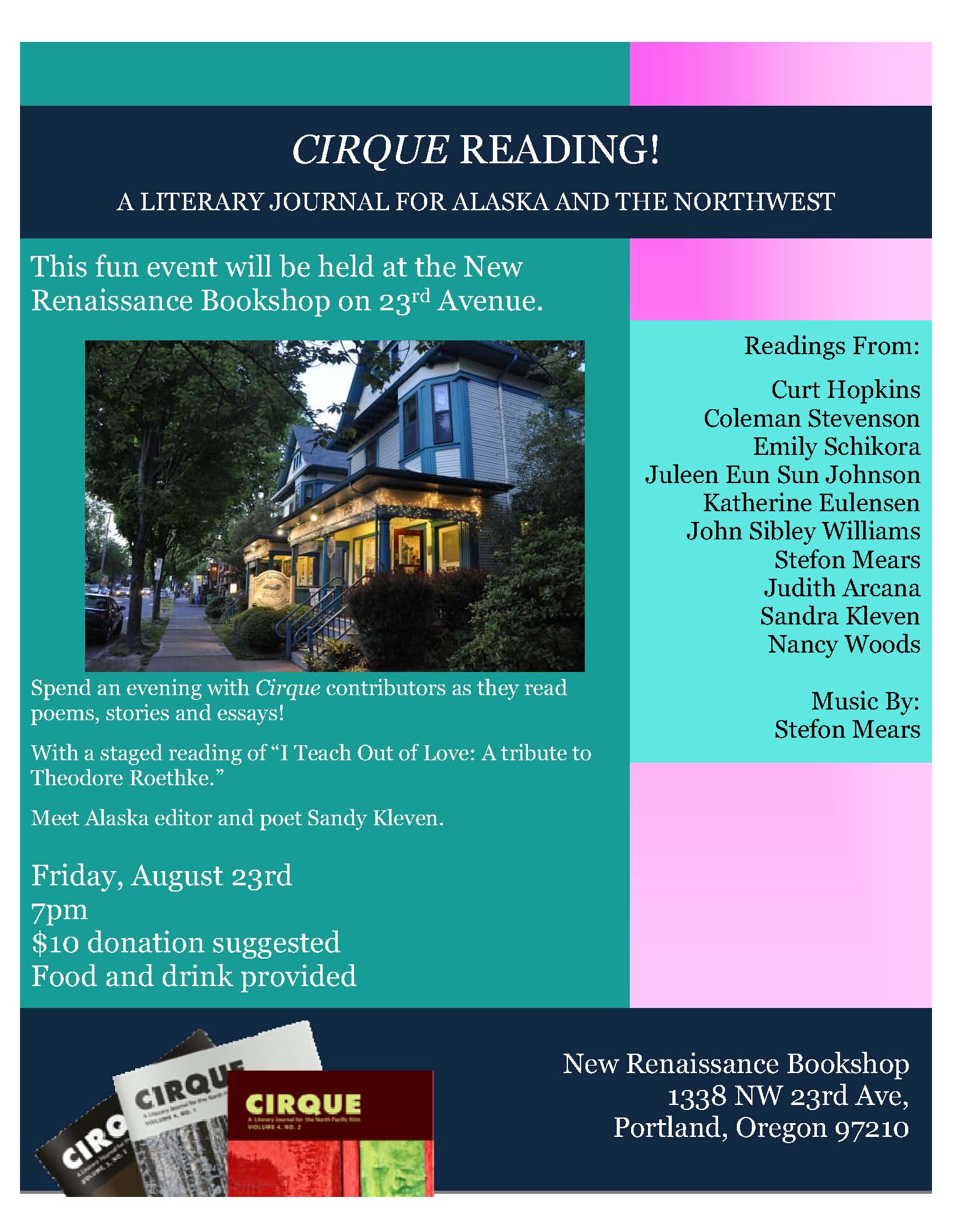
Literary reading: August 23, 2013 in Portland, Oregon
I’ll be taking part in this reading. If you can, stop by and say “Hi.”
Publisher’s Weekly: The Best New Books for the Week of August 19, 2013
To find out what Publisher’s Weekly chose as the best new books for the week of August 19, click here.
Contest: The Doug Fir Fiction Award
Contest: The Doug Fir Fiction Award
CALL FOR SUBMISSIONS (FICTION AWARD)
Bear Deluxe Magazine Presents:
The Doug Fir Fiction Award
Every Story Begins Somewhere
Grand Prize: $1,000, writer’s residency at Sitka Center for Art & Ecology*,
national publication and manuscript review
Finalists: Manuscript review, recognition, publication consideration
Deadline: September 3, 2013 (postmark)**
Award Judge (2012-13): Lidia Yuknavitch&#
39;s most recent books include Dora: A
Headcase, a novel, and The Chronology of Water: A Memoir. She is also the author
of three works of short fiction (Her Other Mouths, Liberty’s Excess, and Real to
Reel) and as well as a book of literary criticism, Allegories of Violence.Her
work has appeared in Ms., The Iowa Review, Exquisite Corpse, Another Chicago
Magazine, Fiction International, Zyzzyva, and elsewhere. Her book Real to Reel
was a finalist for the Oregon Book Award and she is the recipient of awards and
fellowships from Poets and Writers and Literary Arts, Inc. The Chronology of
Water won the Oregon Book Award Reader’s Choice 2012 and the PNBA Award 2012.
Her work appears in the anthologies Life As We Show It, Forms At War, Wreckage
of Reason. She teaches writing, literature, film, and women’s studies in Oregon.
Headcase, a novel, and The Chronology of Water: A Memoir. She is also the author
of three works of short fiction (Her Other Mouths, Liberty’s Excess, and Real to
Reel) and as well as a book of literary criticism, Allegories of Violence.Her
work has appeared in Ms., The Iowa Review, Exquisite Corpse, Another Chicago
Magazine, Fiction International, Zyzzyva, and elsewhere. Her book Real to Reel
was a finalist for the Oregon Book Award and she is the recipient of awards and
fellowships from Poets and Writers and Literary Arts, Inc. The Chronology of
Water won the Oregon Book Award Reader’s Choice 2012 and the PNBA Award 2012.
Her work appears in the anthologies Life As We Show It, Forms At War, Wreckage
of Reason. She teaches writing, literature, film, and women’s studies in Oregon.
Co-sponsor: Sitka Center for Art & Ecology
Associate sponsors: Ashland Creek Press and Hawthorne Books
(Note: Ashland Creek Press and Hawthorne Books will provide manuscript review
for one story of the author’s choice from award winner and finalists.)
Entry Fee: $15
The Bear Deluxe Magazine welcomes submissions of previously unpublished short
stories up to 5,000 words, relating to a sense of place or the natural world,
interpreted as broadly or narrowly as the author defines.
Online submissions, payments and sample issue requests are accepted at
http://www.orlo.org
For complete guidelines: http://www.orlo.org or email bearATorloDOTorg
bear@orlo.org (website is under redesign)
Iowa writing professor receives White House honor
From the San Francisco Chronicle:
Iowa writing professor receives White House honor
Published 2:04 am, Tuesday, July 9, 2013
IOWA CITY, Iowa (AP) — A Pulitzer Prize-winning author teaching creative writing at the University of Iowa will be awarded a National Humanities Medal by President Barack Obama on Wednesday.
Marilynne Robinson is among 12 people to receive the recognition.
A statement from the White House says Robinson will be recognized “for her grace and intelligence in writing” and her novels which are written with “moral strength and lyrical clarity.”
Her novel “Gilead” won the Pulitzer Prize for fiction in 2005 and “Housekeeping” was a finalist for the prize in 1982.
Robinson, a native of Idaho, became a professor at the University of Iowa’s Writers’ Workshop in 1991, where she continues to teach creative writing.
The humanities medal recognizes those whose work deepens the nation’s understanding of history, literature, philosophy and related disciplines.
Artist and Book: 100 Years at Portland Art Museum
Artist & Book: 100 Years
June 22 – September 1, 2013
Portland Art Museum
The livre d’artiste, or artists’ book, offers a rich field for experimentation and collaboration. Blending art with illustration, text, typography, and bookbinding, the livre d’artiste challenges artists in new ways.
Artist & Book celebrates the range of achievement and innovation in livres d’artiste at the Museum and highlights several important recent acquisitions and gifts of work, new and old, including work by Henri Matisse, Leonard Baskin, and Jacob Lawrence. Of special note is a new acquisition on view for the first time, the stunning suite of lithographs Les Trente-six vues de la Tour Eiffel (Thirty-six Views of the Eiffel Tower) created by fin-de-siècle printmaker Henri Rivière from 1888 to 1902. Select loans, including Wassily Kandinsky’s landmark Klänge (Sounds) of 1912 add breadth and depth to the display.
Organized by the Portland Art Museum and curated by Mary Weaver Chapin, Ph.D., Curator of Graphic Arts. The exhibition is supported in part by the Vivian and Gordon Gilkey Endowment for Graphic Arts.
Oregon Literary Followships
OREGON LITERARY FELLOWSHIPS DEADLINE: JUNE 28, 2013
Completed applications for the 2014 Oregon Literary Fellowships are due to Literary Arts by Friday, June 28, 2013. Fellowships are awarded to Oregon residents in poetry, fiction, literary nonfiction, drama and young readers literature. Fellowships are also awarded to publishers. Applications and guidelines are available at http://www.literary-arts.org/oba-home/apply/fellowships, or by contacting Susan Denning at susan@literary-arts.org. Applications will be reviewed by a panel of out-of-state judges. There is no application fee.
Writing contest: Sixfold
Go to sixfold.org for information on this unique contest run by writers or read below.
Voting Results!
Thank you!, everyone who wrote, read, and voted to create these first issues of Sixfold. We all worked to make something greater than any one of us. Thank you for it by being a part of it, and I hope going through the process of reading, commenting, and voting on the three sets of six manuscripts, as well as having received votes and comments on your own manuscript, has given you insight into and appreciation of your and others’ writing.
The three highest-voted manuscripts of the final round in each genre win the first-, second-, or third-place prizes of $1000, $200, or $100. The 20 highest-voted short-story manuscripts and the 40 highest-voted poetry manuscripts will be published soon. Issues will be free to read online, downloadable as PDF, and as e-book for iPhone, Android, Kindle, Nook, and others. Paperback book, too, for about $10.
As you can see from the results, the process works. Voting together, hundreds of writers found the best manuscripts to award and publish. An all-inclusive voting process involving hundreds of writers accumulated into a public, equally-voiced, and transparent decision-making. Writers collectively found and endorsed a broad range of the best writing. Everyone, from the beginning writer to the well-known, can put a good manuscript into the mix and know it will be found by a large, discerning group of readers.
Anecdotally, as someone who has read short story and poetry manuscripts as a reader and editor for over fifteen years, I see that these many-opinion votes select the best manuscripts with greater precision than the usual individual editor or small group of editors.
Additional benefits of open-voting versus closed-set editorial:
- Instead of up to $20 or more for entering a writing contest, $6.
- Instead of little or no response to your submitted manuscript, multiple readers give feedback to your manuscript in their votes, comments, and round advancement.
- Instead of a closed-door, select-group editorial process, everyone involved, and results transparent and public.
- Instead of high-cost, low-sale literary print publishing, Sixfold is free for everyone to read online, download as PDF, and as e-book formats for iPhone, Android, Kindle, Nook, and others.
Please enjoy these first issues, consider entering the next, and e-mail in to sixfold@sixfold.org with your comments and suggestions.
Best,
Garrett Doherty
Publisher
How To Read the Results
Click open each row to see each manuscript’s per-round voting results.
Per round, votes are averaged; the top one-third averages from each round advance to the next round. A voting average from a previous round does not factor in to the next round’s voting average.
Voting follows these conditions:
- Manuscripts are distributed randomly for each round. Each voter receives 6 manuscripts per round to rank-order vote, 6 highest to 1 lowest.
- You never receive your own manuscript to read and vote on.
- You never read and vote on the same manuscript twice.
- If you do not cast a vote by any of the three rounds’ deadline, then your own manuscript is withdrawn from voting, does not advance into any following round, and you can not vote in any following round.
Why do some manuscripts receive fewer or more than 6 votes in round 1, 18 in round 2, 54 in round 3?
Per round, the database assigns manuscripts to voters as evenly as possible, so that each manuscript ideally receives 6 votes in round 1, 18 in round 2, 54 in round 3. By chance, a manuscript may receive fewer or more votes because:
- The system may assign a small number of random manuscripts one more or one less voter per round in order to assign as evenly as possible.
- Voter participation: a manuscript will receive one less vote if the voter assigned to that manuscript does not vote. The per-round averaged rank score is calculated only from votes received.
There was excellent, robust voter participation. 94% of round 1 poetry manuscripts and 96% of round 1 short story manuscripts each received 4 or more votes. 9 short story manuscripts and 11 poetry manuscripts in round 1 received 3 or fewer votes and did not advance into the second round for further voting. Though it is impossible to say what a manuscript’s voting average would be had it received more votes, the writers of these manuscripts would seem underserved by the voting process, and will be offered refund on entry fee.
Manuscripts without any voting scores represent entries withdrawn by the entrant or rejected before voting began (because manuscript was entered into the wrong genre, exceeded required length, etc.).
 Nancy Woods